
How to Create an International Website as a Winery in the Pacific Northwest
Welcome, winery owners, vineyard managers, and wine industry professionals in the Pacific Northwest!
The Pacific Northwest wine industry is on the world stage—your website should be too. Building an international website means more than just translating words; it’s about telling your story in a way that resonates with wine lovers from London to Tokyo, Paris to Toronto. This guide will show you, step by step, how to make your winery’s website truly approachable, culturally inclusive, and globally accessible.

Table of Contents
Introduction: Why International Web Presence Matters for PNW Wineries
Know Your International Audience
Language and Translation Strategy
Cultural Considerations by Market
Practical Language and Content Tips
Technical Setup: Internationalization vs. Localization
Platform Recommendations
SEO for International Audiences
Formatting Details That Matter
Shipping and Payment — Navigating the Complexity
Privacy, GDPR, and Legal Compliance
Visual Design and UX for Global Audiences
Content Strategy for International Audiences
Practical Checklist: 20-Point Action List
Conclusion: Your Story, the World’s Table
Introduction: Why International Web Presence Matters for PNW Wineries
The Pacific Northwest (PNW) is no longer a hidden gem in the wine world—it’s a global player. Washington State is the second-largest wine-producing state in the US, and Oregon is the fourth. Together, they export to over 60 countries, with Washington alone generating over $47 million in export sales and an impressive 8.8% compound annual growth rate. Canada is the largest export market, accounting for 45% of Oregon’s export sales. Other key markets include the UK, Europe, Japan, and Asia.
The PNW is often described as North America’s most “Europe-like” wine region, with Oregon’s Willamette Valley sitting at the same latitude as Burgundy, France. This isn’t just marketing spin—Burgundian producers have been investing in Oregon since the 1980s, and Willamette Valley Pinot Noir won “Best in Show” at the 2023 Decanter World Wine Awards. Washington’s Cabernet Sauvignon and Riesling are recognized globally for their quality and value.
Why does this matter for your website?
Because your next best customer might be in London, Tokyo, or Toronto. A website that feels “local” to them—clear, welcoming, and culturally attuned—can turn a curious visitor into a lifelong fan.
Know Your International Audience
Before you can speak to the world, you need to know who’s listening. The PNW’s international wine audience is diverse, each group bringing its own expectations, knowledge, and cultural context.
Key International Audiences
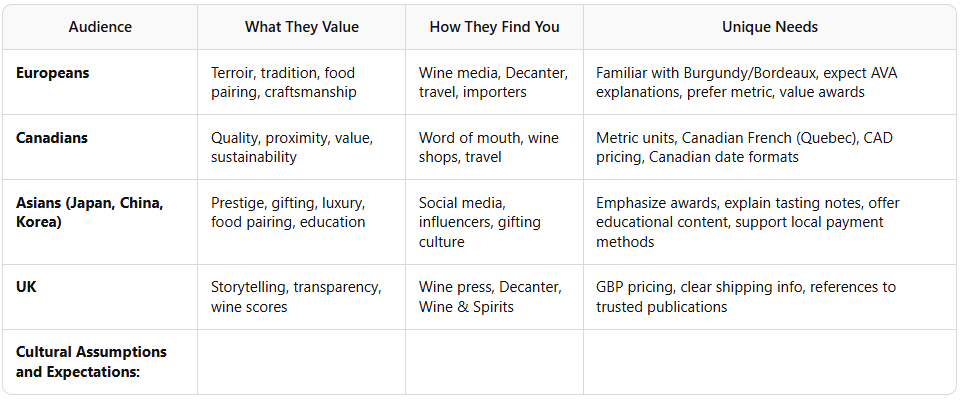
Europeans may expect a focus on terroir and tradition.
Canadians are close neighbors but appreciate when you acknowledge their unique identity.
Asian consumers may be newer to wine, value prestige, and seek educational content.
UK buyers are sophisticated, price-conscious, and trust established wine media.
Key Finding:
Each audience comes to your website with different assumptions. Your job is to meet them where they are, not where you are.
Language and Translation Strategy
Machine Translation vs. Professional Human Translation
Machine Translation (Google Translate, DeepL): Fast and cheap, but often inaccurate, especially with wine terminology and cultural nuance.
Professional Human Translation: Essential for customer-facing content. A professional translator who understands wine can capture the nuance, tone, and context that machines miss.
Best Practice:
Use machine translation for drafts or internal use, but always have a professional (ideally a native speaker familiar with wine) review and finalize your content.
Translation vs. Localization
Translation: Converts words from one language to another.
Localization: Adapts idioms, cultural references, tone, and context. For example, “earthy Pinot Noir” might be translated differently for a French vs. Japanese audience.
Hybrid Approach:
Machine translation + human post-editing = speed and quality.
Technical Aspects
Avoid embedding text in images: Text in images can’t be translated or indexed by search engines.
Design for text expansion: Some languages (like German or Russian) need up to 20% more space than English.
Support Unicode: Ensures your site can display all global character sets (Japanese, Chinese, Cyrillic, etc.).
Cultural Considerations by Market
European Audiences
Focus: Terroir, tradition, food pairing, appellation, craftsmanship.
How to Connect:
Compare Willamette Valley Pinot Noir to Burgundy.
Highlight AVA (American Viticultural Area) as the US equivalent of European appellations.
Emphasize restraint, structure, and food-friendliness.
Canadian Audiences
Focus: Quality, sustainability, value, proximity.
How to Connect:
Use metric measurements (hectares, liters).
Show prices in CAD and use Canadian date formats.
Offer French-language content for Quebec.
Explain where your region is—don’t assume familiarity with US geography.
Asian Audiences (Japan, China, Korea)
Focus: Prestige, gifting, luxury, food pairing, education.
How to Connect:
Emphasize awards, scores, and limited production.
Offer simple, educational content (tasting guides, food pairings).
Avoid Western idioms and humor.
Support local payment methods (Alipay, WeChat Pay).
UK Audiences
Focus: Storytelling, transparency, wine scores.
How to Connect:
Reference trusted publications (Decanter, Wine & Spirits).
Show prices in GBP.
Be transparent about shipping and taxes.
General Principles
Avoid American idioms, slang, and cultural references.
Don’t assume knowledge of US wine laws or geography.
Explain the AVA system and regional context.
Practical Language and Content Tips
Write in clear, plain English: Avoid idioms like “across the pond,” “fall harvest,” or sports metaphors.
Explain geographic terms: “Oregon’s Willamette Valley sits at the same latitude as Burgundy, France.”
Describe the AVA system: “An AVA (American Viticultural Area) is a government-designated wine region, similar to an appellation in Europe.”
Translate tasting notes into sensory language: Instead of “terroir-driven,” say “with flavors of ripe cherry, earth, and subtle spice.”
Include a glossary or FAQ: Define wine terms for international visitors.
Key Takeaway:
Clarity and context are your friends. Assume nothing—explain everything.
Technical Setup: Internationalization (i18n) vs. Localization (l10n)
Internationalization (i18n)
Definition: The technical foundation that makes your site adaptable for any language or region.
How:
Separate content from code.
Use Unicode encoding.
Design flexible layouts for text expansion and right-to-left (RTL) languages.
When: During the build phase. Retrofitting later is expensive and time-consuming.
Localization (l10n)
Definition: The ongoing process of adapting your content for specific markets.
How:
Translate text.
Adapt images, colors, and content for cultural relevance.
Format dates, currencies, and measurements for each locale.
Recommendation:
Build with i18n in mind from day one. It’s the best investment you can make for future growth.
Platform Recommendations

SEO for International Audiences (hreflang)
What Are Hreflang Tags?
Definition: HTML signals that tell Google which version of a page to show users based on their language and location.
Syntax:
ISO 639-1 language codes + ISO 3166-1 Alpha-2 country codes (e.g., en-US, en-GB, fr-FR, ja-JP, de-DE).
Self-referencing and Bidirectional:
Every language version must reference all other versions, including itself.
x-default:
Used for a fallback/global page or language selector.
Implementation Tips
Use Google Search Console, Screaming Frog, or Ahrefs to validate hreflang implementation.
URL Structure Options:
Subdirectories (/fr/, /de/): Most practical and SEO-friendly for small wineries.
Subdomains (fr.winery.com): More complex, less SEO benefit.
Separate ccTLDs (winery.fr): Expensive, best for large brands.
Avoid auto-redirecting based on IP address: Let users choose their language.
Formatting Details That Matter
Dates:
US format (MM/DD/YYYY) is confusing to most of the world.
Use DD/MM/YYYY for Europe, YYYY-MM-DD for Asia, or write dates in plain language (15 March 2024).
Measurements:
Use metric as the primary unit (750ml bottles, 12L cases, hectares).
The US is one of only three countries still using imperial measurements.
Currency:
Show prices in multiple currencies or clearly indicate USD.
Consider currency conversion widgets.
Temperature:
Use Celsius as the standard, with Fahrenheit in parentheses if needed.
Shipping and Payment — Navigating the Complexity
Be transparent about shipping limitations:
US alcohol shipping laws are complex and often restrict international shipping.
Clearly state which countries you ship to (or cannot).
Create a dedicated “International Orders” or “Shipping Information” page:
Explain options for international visitors—distributors, wine clubs, or international retailers.
Payment:
Offer multiple payment methods—credit cards, PayPal, Alipay, WeChat Pay.
Currency conversion:
If you can’t dynamically convert prices, at least show clear USD pricing and link to a conversion tool.
Age verification:
Include clear age verification and responsible drinking messaging.
Free Guide: Winery Website Conversion Checklist
Privacy, GDPR, and Legal Compliance
GDPR:
The EU’s General Data Protection Regulation requires explicit consent before collecting personal data.
Install a GDPR-compliant cookie consent banner (CookieYes, Complianz for WordPress).
Canada’s PIPEDA:
Similar requirements for Canadian visitors.
Age verification gating:
Comply with local regulations for alcohol websites.
Email marketing:
Use clear opt-in systems with separate consent for marketing.
Visual Design and UX for Global Audiences
Color symbolism:
Red = luck in China, mourning in some African cultures.
White = purity in the West, mourning in some Asian cultures.
Earth tones, deep greens, burgundy, and gold are universally associated with quality and nature.
Photography:
Use universal imagery—vineyards, landscapes, wine.
Avoid US-centric settings (football games, Thanksgiving).
Navigation:
Keep it clear and simple.
Explain terms like “Wine Club.”
Mobile optimization:
Essential globally, especially in Asia.
Font choices:
Use Unicode-compliant fonts for multilingual support.
RTL support:
If targeting Arabic or Hebrew speakers, support right-to-left text layout.
Page speed:
Use a CDN (Cloudflare, AWS CloudFront) for fast global load times.
Content Strategy for International Audiences
Tell your story:
The narrative of a small family winery in the PNW, producing wines at the same latitude as Burgundy, is compelling worldwide.
“Our Region” or “Our Terroir” page:
Explain the PNW in geographic context—include a map showing Oregon/Washington in relation to Europe.
Emphasize sustainability:
Organic, biodynamic, Salmon-Safe, LIVE certification—these resonate globally.
Showcase international awards:
Decanter scores, Wine Spectator ratings, Wine & Spirits Top 100 recognition.
Media/press page:
Include international coverage.
Blog content:
Write posts that explain PNW wine culture to outsiders.
Examples: “Why Willamette Valley Pinot Noir is Different from Burgundy,” “A Guide to Washington State Wine Regions for the Global Wine Lover.”
Practical Checklist: 20-Point Action List
Define your key international audiences.
Write all content in clear, plain English.
Hire professional translators for main languages.
Localize—not just translate—your content.
Design flexible templates for text expansion and RTL support.
Use Unicode encoding for all text.
Avoid embedding text in images.
Explain US-specific terms and geography.
Show prices in multiple currencies or clearly indicate USD.
Use metric units as the default.
Format dates in a globally understandable way.
Implement hreflang tags for all language versions.
Let users choose their language—don’t auto-redirect.
Be transparent about shipping restrictions.
Offer multiple international payment methods.
Install GDPR-compliant cookie consent and privacy policy.
Include age verification and responsible drinking messaging.
Use culturally neutral, high-quality photography.
Optimize for mobile and fast global load times.
Highlight your region, sustainability, and international awards.
Conclusion: Your Story, the World’s Table
The Pacific Northwest wine industry has earned its place on the global wine map. Oregon’s Willamette Valley is mentioned in the same breath as Burgundy. Washington’s Cabernet Sauvignon competes with Napa while offering better value. These are stories the world wants to hear.
A well-crafted international website is the most powerful tool a small PNW winery has to tell that story globally. The investment is modest compared to the opportunity. The next buyer of your allocation-only Pinot Noir might be logging in from Tokyo, London, or Paris—make sure your website welcomes them.
Final Thought:
The world is thirsty for your story. Let’s make sure they can find it, understand it, and fall in love with your wine—no matter where they are.
Thank you for reading! If you found this post helpful, please share it with other winery owners and industry friends. Cheers to your success in the Pacific Northwest wine world!
Let’s raise a glass to your success—both in wine and beyond! 🍷
As a web designer who specializes in the wine industry, I help wineries and vineyards create beautiful, effective websites and digital marketing strategies tailored to their unique stories and audiences. If you’re ready to boost your online presence and connect with new customers, let’s have a chat about how strategic & smart web design can take your winery to the next level!
Cheers to your success in the wine industry!
Maike
The Golden Square Design Studio
Where Vision Meets Innovation
Creating Stunning & Strategic Websites for Online Success