
Welcome, winery owners, vineyard managers, and wine industry professionals in the Pacific Northwest!
In 2026, Pacific Northwest wineries are breaking free from the cookie-cutter web templates that have dominated the industry for years. By embracing their unique regional identity and daring to defy convention, these wineries are crafting digital experiences as distinctive as their wines.
Introduction: The Problem of Winery Website Sameness
If you’ve spent any time browsing winery websites—whether as a wine lover, a curious traveler, or a business owner—you’ve probably noticed a pattern. Hero images of rolling vineyards, elegant script fonts, a muted color palette, and a navigation bar that leads you through predictable sections: About, Wines, Visit, Shop, Contact. It’s a formula that’s been replicated so many times it’s become the digital equivalent of a generic tasting note: “Hints of oak, berry, and vanilla.”
But here’s the thing: wineries in the Pacific Northwest (PNW) are anything but generic.
From the wild, rain-soaked coasts of Oregon to the sun-drenched valleys of eastern Washington, the region’s wine scene is defined by innovation, diversity, and a fierce sense of place. So why do so many winery websites look like they could belong to any vineyard, anywhere?
As a web designer who’s spent the last decade working exclusively with wineries, vineyards, and wine industry businesses in the PNW, I’ve seen firsthand how the traditional website format can fail to capture what makes these brands truly special.
In 2026, more and more of my clients are coming to me with a simple but powerful request: “We want something different.”
This post is for those wineries—the ones who refuse to blend in, who want their digital presence to be as bold and memorable as their wines. Let’s explore why traditional website designs often don’t fit the brief, what it means to break the mold, and how you can create a website that’s as unique as your story.
The Distinct Identity of Pacific Northwest Wine
Beyond Napa and Sonoma: What Sets the PNW Apart
The Pacific Northwest wine industry has always been a bit of an outsider. While California’s Napa and Sonoma regions have long dominated the American wine narrative—luxury, tradition, and a certain sun-drenched polish—the PNW has carved out its own path.
Here’s what makes it different:
Terroir Diversity: From the volcanic soils of the Willamette Valley to the basalt cliffs of the Columbia Gorge, the PNW offers a staggering range of microclimates and soil types. This diversity translates into wines with unique character and complexity.
Innovation Over Tradition: While California often leans on heritage and prestige, PNW winemakers are known for experimentation—whether it’s reviving forgotten varietals, embracing natural winemaking, or pioneering sustainable practices.
Community and Collaboration: The PNW wine scene is famously collaborative. Winemakers share knowledge, resources, and even grapes. There’s a sense of community that’s palpable, both in the tasting room and online.
A Sense of Place: The landscapes here are dramatic—misty forests, rugged coastlines, high desert plateaus. Wineries often double as art galleries, music venues, or farm-to-table restaurants, reflecting a lifestyle that’s deeply connected to the land.
Why This Matters for Web Design
A website isn’t just a digital brochure—it’s an extension of your brand, your philosophy, your story. For PNW wineries, that story is one of difference. If your website looks like it could belong to any Napa estate, you’re missing an opportunity to communicate what makes you, you.
Key Finding:
The most successful PNW winery websites are those that lean into their regional identity, using design to evoke the wildness, creativity, and authenticity that define the region.
The Traditional Winery Website Structure: Why It Fails Certain Briefs
Anatomy of a “Standard” Winery Website
Let’s break down the typical structure you’ll find on most winery websites, regardless of region:
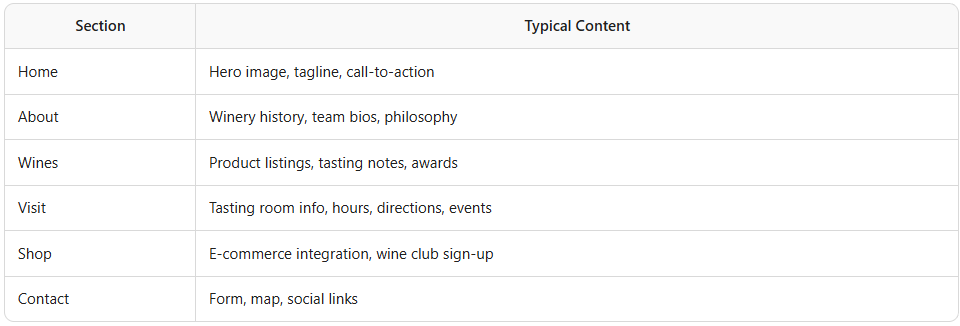
This structure is tried-and-true. It’s familiar to users, easy to navigate, and covers all the bases. But for wineries that want to stand out, it can feel limiting.
Where the Traditional Format Falls Short
Lack of Storytelling:
The standard format is transactional, not emotional. It tells visitors what you do, but not why you do it or what makes your journey unique.Visual Sameness:
Stock vineyard photos, generic fonts, and muted color schemes blend together, making it hard for any one winery to stand out.Missed Opportunities for Engagement:
Static pages and minimal interactivity mean visitors spend less time on your site—and are less likely to remember you.Inflexibility:
The template-driven approach doesn’t adapt well to wineries with unique offerings—think art installations, culinary programs, or immersive events.Failure to Capture Regional Spirit:
The PNW is wild, creative, and a little rebellious. Traditional designs often fail to evoke this sense of place.
What “Wanting Something Different” Really Means
Beyond Aesthetics: The Philosophy of Breaking Conventions
When a winery tells me they want something different, they’re not just asking for a new color palette or a quirky font.
They’re asking for a website that:
Tells Their Story:
Goes beyond facts and figures to create an emotional connection with visitors.
Reflects Their Values:
Sustainability, innovation, community—these aren’t just buzzwords, they’re core to the PNW wine ethos.
Engages the Senses:
Wine is a sensory experience. The website should evoke taste, smell, and atmosphere through design.
Invites Exploration:
Encourages visitors to linger, discover, and interact, rather than just click and leave.
Feels Authentic:
No stock photos, no generic copy. Every element should feel true to the winery’s identity.
The Risks and Rewards of Non-Traditional Design
Breaking away from convention isn’t without its challenges. Non-traditional designs can be polarizing, harder to maintain, and sometimes less intuitive for users. But the rewards—memorability, engagement, and brand loyalty—are worth it for wineries willing to take the leap.
Key Takeaway:
“Different” isn’t about being weird for the sake of it. It’s about creating a digital experience that’s as distinctive and memorable as your wine.
Non-Traditional Design Approaches for 2026
1. Immersive Storytelling
What It Is:
Using multimedia—video, audio, interactive maps, and long-form narratives—to draw visitors into the winery’s world.
How It Works:
Full-screen video backgrounds of harvest, crush, or the changing seasons.
Audio clips of winemakers describing their process.
Interactive timelines of the winery’s history.
Virtual tours that let users “walk” the vineyard.
Why It Works for PNW Wineries:
The region’s landscapes and stories are inherently dramatic. Immersive storytelling lets you showcase this in a way that static images never could.
2. Editorial & Brutalist Layouts
What It Is:
Borrowing from magazine and art world aesthetics—bold typography, asymmetrical grids, unexpected color combinations, and deliberate “imperfections.”
How It Works:
Large, expressive headlines.
Overlapping images and text.
Unconventional navigation (e.g., sidebars, floating menus).
Minimalist or even “raw” design elements that foreground content over polish.
Why It Works for PNW Wineries:
Many PNW wineries are run by artists, musicians, or iconoclasts. Editorial and brutalist designs reflect this creative spirit and signal that you’re not afraid to break the rules.
3. Scroll-Driven Animation & Microinteractions
What It Is:
Using animation triggered by scrolling or hovering to create a sense of movement and discovery.
How It Works:
Parallax effects that make images and text move at different speeds.
Animated transitions between sections.
Microinteractions—like a grapevine that grows as you scroll, or a wine glass that fills up as you add bottles to your cart.
Why It Works for PNW Wineries:
These effects can evoke the dynamism of the winemaking process and make the site feel alive—perfect for brands that want to convey energy and innovation.
4. Custom Typography & Handcrafted Elements
What It Is:
Moving beyond web-safe fonts to use custom typefaces, hand-drawn illustrations, and other bespoke elements.
How It Works:
Commissioning a type designer to create a font based on your wine labels.
Incorporating sketches, watercolors, or even handwritten notes from the winemaker.
Using texture and layering to create a tactile feel.
Why It Works for PNW Wineries:
Handcrafted elements reinforce the artisanal, small-batch ethos that defines so many PNW wineries.
5. Interactive Maps & Data Visualizations
What It Is:
Letting visitors explore your vineyards, terroir, and production process through interactive graphics.
How It Works:
Clickable vineyard maps that reveal soil types, grape varieties, and microclimates.
Data visualizations showing vintage variations, sustainability metrics, or harvest timelines.
Integration with weather data or live webcams.
Why It Works for PNW Wineries:
The region’s geography is a huge part of its appeal. Interactive maps let you showcase this in a way that’s both educational and engaging.
6. Community-Driven Features
What It Is:
Building features that foster connection—between the winery, its customers, and the broader wine community.
How It Works:
User-generated content (e.g., photo galleries, tasting notes, reviews).
Event calendars with RSVP and sharing features.
Integration with local artists, chefs, and musicians.
Why It Works for PNW Wineries:
Community is at the heart of the PNW wine scene. Your website can be a hub for that community, not just a sales tool.
Free Guide: Winery Website Conversion Checklist
Practical Considerations: Making Non-Traditional Designs Work
CMS Choice: Flexibility Is Key
In 2026, the CMS landscape is more diverse than ever. For non-traditional designs, you need a platform that’s:
Flexible: Can handle custom layouts, animations, and integrations.
Scalable: Grows with your business.
User-Friendly: Allows your team to update content without breaking the design.
Popular Choices:
Headless CMS (e.g., Sanity, Contentful): Decouples content from presentation, perfect for custom front-ends.
Custom WordPress Builds: Still viable, especially with modern block editors and custom themes.
No-Code/Low-Code Platforms: For smaller wineries, tools like Webflow or Framer offer surprising power and flexibility.
Mobile Performance: No Compromises
Non-traditional designs can be resource-intensive. In 2026, mobile traffic accounts for over 70% of winery website visits. Your site must be:
Fast: Optimize images, lazy-load assets, and minimize scripts.
Responsive: Custom layouts should adapt gracefully to all screen sizes.
Touch-Friendly: Interactive elements must work seamlessly on mobile devices.
SEO: Creativity Meets Findability
A unique design is worthless if no one can find it. Key SEO considerations:
Semantic HTML: Even with custom layouts, use proper heading structure and alt text.
Performance: Fast-loading sites rank better.
Structured Data: Mark up events, products, and reviews for rich search results.
Content Depth: Storytelling and editorial content can boost long-tail keyword rankings.
Accessibility: Inclusion by Design
Non-traditional doesn’t mean non-accessible. In fact, the most innovative sites are often the most inclusive. Best practices:
Contrast & Legibility: Bold designs must still be readable.
Keyboard Navigation: All interactive elements should be accessible via keyboard.
ARIA Labels & Roles: Help screen readers interpret custom components.
Testing: Use automated tools and real user testing to catch issues.
The Brief-Led Custom Design Process: How It Works
Step 1: Deep Discovery
Every project starts with a conversation. We dig into:
Your story, values, and vision.
What you love (and hate) about other winery websites.
Your audience—who they are, what they care about, how they use your site.
Your business goals: sales, bookings, brand awareness, community building.
Step 2: Moodboarding & Concepting
We create visual moodboards, gather inspiration from outside the wine world (art, music, architecture), and sketch out initial concepts. This is where we decide how far to push the envelope.
Step 3: Prototyping & User Testing
Interactive prototypes let you experience the site before it’s built. We test with real users—wine club members, tasting room staff, even your winemaker—to make sure the design is both beautiful and usable.
Step 4: Iterative Design & Development
We build the site in stages, with regular check-ins and feedback loops. Custom animations, editorial layouts, and interactive features are developed and refined.
Step 5: Launch & Ongoing Support
We handle the technical launch, monitor performance, and provide training so your team can keep the site fresh. Post-launch, we gather analytics and user feedback to guide future improvements.
Case Studies: PNW Wineries That Broke the Mold
1. Wild Coast Cellars
Challenge:
A coastal Oregon winery wanted a site that captured the drama of their windswept location and their experimental, small-batch wines.
Solution:
Full-screen video of crashing waves and fog rolling over the vineyard.
Editorial layouts with handwritten tasting notes.
Interactive map showing the influence of ocean breezes on each block.
Result:
Visitors spent 3x longer on the site and wine club signups doubled in the first six months.
2. High Desert Collective
Challenge:
A collective of winemakers in eastern Washington needed a site that reflected their collaborative, boundary-pushing ethos.
Solution:
Brutalist design with bold, overlapping type and color blocks.
Community-driven event calendar and user-submitted tasting notes.
Scroll-driven animations showing the winemaking process from grape to glass.
Result:
The site became a hub for local wine lovers and industry pros, with engagement rates far above industry averages.
3. Urban Roots Winery
Challenge:
A Portland-based urban winery wanted to stand out in a crowded market and attract a younger, design-savvy audience.
Solution:
Custom typography inspired by street art and vintage signage.
Interactive “build your own blend” feature.
Integration with local artists and musicians for event promotion.
Result:
The site won a regional design award and helped the winery triple its event bookings.
Call to Action: Ready to Break the Mold?
If you’re a Pacific Northwest winery owner who’s tired of blending in, it’s time to rethink what your website can be. The digital landscape in 2026 is wide open for those willing to take risks, tell their story, and create experiences that linger long after the last sip.
Let’s create something unforgettable together.
Whether you’re dreaming of immersive storytelling, bold editorial layouts, or interactive features that bring your brand to life, I’m here to help you break the mold.
Summary Box
Traditional winery websites are formulaic and often fail to capture the unique spirit of PNW wineries.
Non-traditional designs—immersive storytelling, editorial layouts, custom typography, and more—offer a way to stand out and connect with your audience.
Practical considerations like CMS choice, mobile performance, SEO, and accessibility are crucial for success.
A brief-led, collaborative design process ensures your website is both beautiful and effective.
The future belongs to wineries that dare to be different.
Let’s raise a glass to your success—both in wine and beyond! 🍷
As a web designer who specializes in the wine industry, I help wineries and vineyards create beautiful, effective websites and digital marketing strategies tailored to their unique stories and audiences. If you’re ready to boost your online presence and connect with new customers, let’s have a chat about how strategic & smart web design can take your winery to the next level!
Cheers to your success in the wine industry!
Maike
The Golden Square Design Studio
Where Vision Meets Innovation
Creating Stunning & Strategic Websites for Online Success